More than $1.5 million in fines have been handed out to businesses failing to protect personal data in California. As data privacy becomes a top concern, both consumers and companies face new challenges and responsibilities. Understanding California’s evolving privacy laws helps businesses avoid costly penalties while giving individuals more control over their personal information than ever before.
Key Takeaways
| Point | Details |
|---|---|
| CCPA and CPRA Framework | California’s data privacy laws mandate robust consumer rights and compliance measures, significantly impacting how businesses manage data. |
| Expanded Consumer Rights | The CPRA provides enhanced consumer rights including data correction and limits on sensitive data usage, necessitating business adjustments to comply. |
| Increased Enforcement and Penalties | Non-compliance can result in severe financial penalties, with the CPRA tripling fines for violations involving minors, emphasizing strict adherence to regulations. |
| Mandatory Compliance Measures | Businesses must develop transparent policies, conduct risk assessments, and establish clear opt-out mechanisms to protect consumer rights and avoid penalties. |
Key Takeaways for CCPA & CPRA Compliance in California
- Understanding Data Privacy Laws In California
- Key Provisions Of Ccpa And Cpra
- Business Obligations And Compliance Requirements
- Consumer Rights And Opt-Out Mechanisms
- Risks, Penalties, And Enforcement Actions
Understanding Data Privacy Laws in California
California has emerged as a pioneer in digital privacy protection, establishing some of the most comprehensive data privacy regulations in the United States. The California Consumer Privacy Act (CCPA) and its more recent successor, the California Privacy Rights Act (CPRA), represent significant milestones in protecting consumer data rights and holding businesses accountable for responsible data management.
According to research from the California Privacy Protection Agency, the CPRA expanded consumer protections by introducing critical new rights for individuals. These groundbreaking provisions include:
- Preventing businesses from sharing personal data without consent
- Enabling consumers to correct inaccurate personal information
- Limiting the use of sensitive personal data
- Establishing a dedicated privacy enforcement agency
Academic research reveals a complex implementation landscape. A study analyzing 95 privacy policies discovered significant variations in how organizations interpret and present privacy disclosures. As research from arXiv indicates, many privacy policies remain vague, which can undermine consumers’ ability to make truly informed decisions about their personal data.
For businesses operating in California, understanding these nuanced privacy laws is no longer optional – it’s a critical compliance requirement.
 The CPRA, which became fully effective on January 1, 2023, applies to data collected as far back as January 1, 2022, meaning companies must retrospectively assess and potentially modify their data handling practices to ensure full legal alignment.
Key Provisions of CCPA and CPRA
California’s data privacy laws are designed to give consumers unprecedented control over their personal information. The California Consumer Privacy Act (CCPA) and California Privacy Rights Act (CPRA) introduce comprehensive requirements that fundamentally change how businesses handle consumer data.
According to research from Ketch, businesses must now implement several critical compliance measures:
- Provide clear privacy notices
- Include a “Do Not Sell My Personal Information” link
- Establish consumer rights request processes
- Complete consumer identity verification
- Maintain recordkeeping for at least two years
- Update privacy policies annually
- Train employees on data privacy protocols
The CPRA significantly expands these requirements by introducing more nuanced protections. As documented by Wikipedia, the law now defines sensitive personal information more comprehensively, covering categories like precise geolocation, genetic data, and racial information. This expansion allows consumers to limit how such sensitive data can be used and processed.
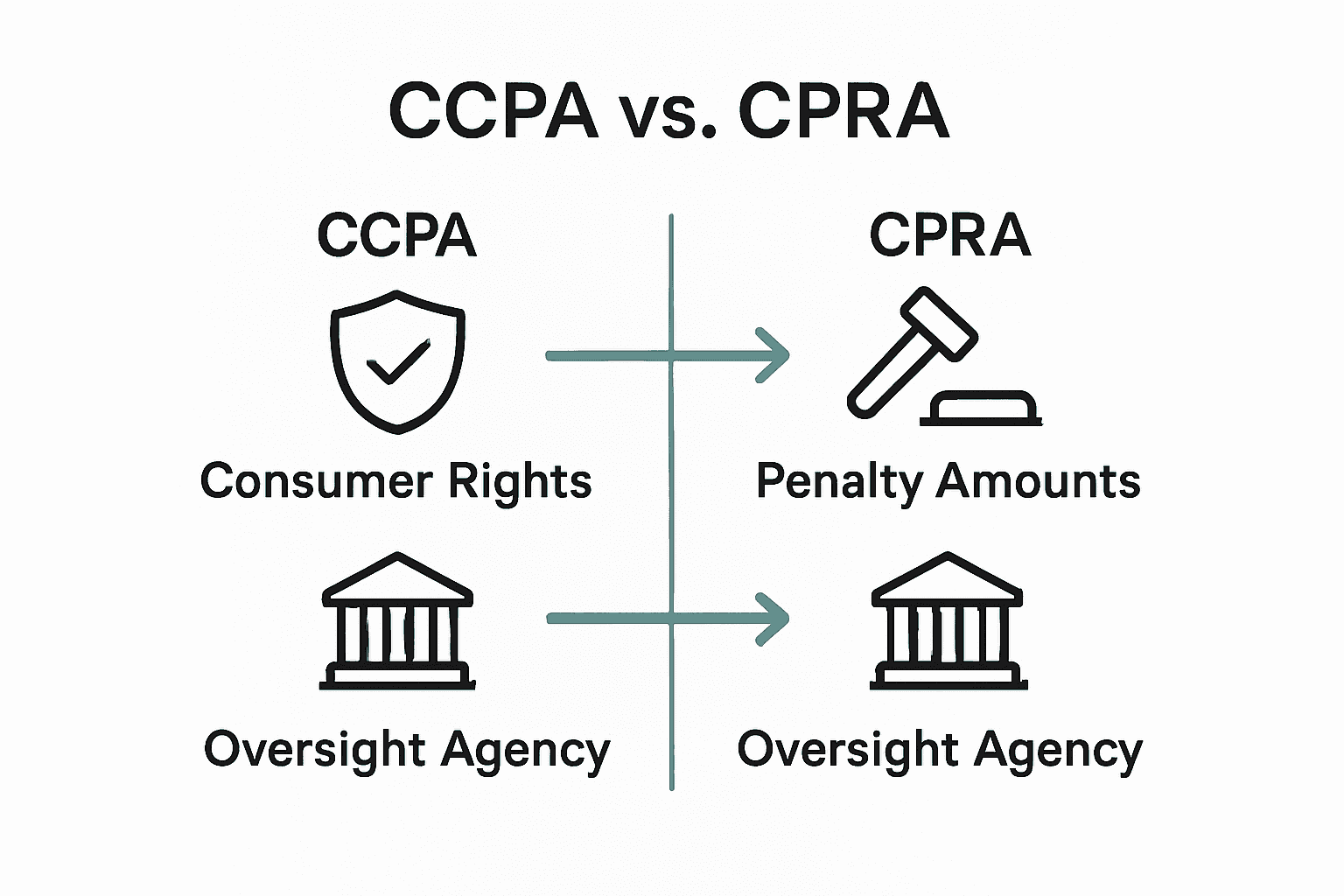
Here’s a comparison of the CCPA and CPRA provisions:
| Provision | CCPA | CPRA (Expanded) |
|---|---|---|
| Consumer Rights | Access Delete Opt-Out |
Correct data Limit use Expanded opt-out |
| Sensitive Data Categories | Not specifically defined | Includes geolocation Genetic data Racial data |
| Enforcement Agency | California Attorney General | Privacy Protection Agency |
| Penalties | Up to $2,500 per violation | Up to $7,500 Higher for minors |
| Do Not Sell/Share Requirement | Do Not Sell link | Do Not Sell/Share link GPC support |
| Data Retention Limits | Not specified | Must minimize retention |
| Policy Update Frequency | Annually | Annually |
One of the most critical enhancements is the increased enforcement mechanism. The CPRA triples potential fines for violations involving minors, with penalties reaching up to $7,500. Moreover, the law prohibits businesses from retaining personal data longer than necessary and establishes the California Privacy Protection Agency to ensure strict compliance and assessment of potential violations.
Business Obligations and Compliance Requirements
Data privacy compliance is no longer an optional consideration for California businesses. According to the California Department of Justice, companies must now meet a comprehensive set of requirements that demand proactive and strategic data management approaches.
Research from Ketch outlines several critical compliance obligations businesses must implement:
- Develop transparent and clear privacy notices
- Create functional opt-out and “Do Not Share My Personal Information” links
- Establish robust consumer rights request procedures
- Implement reliable consumer identity verification processes
- Maintain detailed recordkeeping documentation
- Conduct regular employee privacy training
- Update privacy policies annually
The compliance landscape goes beyond mere documentation. Businesses must now conduct thorough risk assessments for data processing activities and implement strict data retention limitations.
This means companies can no longer collect and store consumer information indefinitely but must have clear, justifiable reasons for maintaining personal data.
Non-compliance carries significant financial risks. The California Privacy Protection Agency has the authority to impose substantial penalties, with fines potentially reaching $7,500 for intentional violations. For businesses operating in California, understanding and meticulously implementing these requirements is not just a legal obligation – it’s a critical business imperative that protects both consumer rights and organizational integrity.
Consumer Rights and Opt-Out Mechanisms
California’s data privacy laws empower consumers with unprecedented control over their personal information. Consumer rights are at the heart of the California Consumer Privacy Act (CCPA) and California Privacy Rights Act (CPRA), providing individuals with robust mechanisms to protect their digital privacy.
According to the California Office of the Attorney General, consumers have critical opt-out capabilities, including:
- Request businesses stop selling or sharing personal information
- Utilize a mandatory “Do Not Sell or Share My Personal Information” link
- Accept opt-out signals like Global Privacy Control (GPC)
- Receive confirmation of opt-out requests within 15 business days
Special protections exist for minors. Consent requirements are particularly strict for individuals under 16, with businesses required to obtain affirmative opt-in authorization before collecting or sharing their data. Research from Reuters highlights that California’s approach represents one of the most stringent consent models in the United States.
Moreover, these rights aren’t just theoretical. Businesses must have clear, accessible processes for consumers to exercise their privacy preferences. This means providing multiple channels for opt-out requests, maintaining transparent documentation, and responding promptly to consumer inquiries about data usage and sharing.
Risks, Penalties, and Enforcement Actions
Data privacy violations in California carry substantial financial and reputational risks for businesses. The California Privacy Protection Agency has demonstrated its commitment to strict enforcement through increasingly significant penalties targeting companies that fail to comply with data protection regulations.
According to recent enforcement data from TrustArc, recent penalties illustrate the complex landscape of potential violations:
- Healthline Media LLC was fined $1.55 million for inappropriate health data sharing
- American Honda faced a $632,500 penalty for excessive consumer identity verification
- Todd Snyder, Inc. paid $345,178 for misconfigured opt-out processes
Historic cases from the California Attorney General’s Office further underscore the breadth of potential infractions. For instance, Sephora was penalized $1.2 million in 2022 for failing to process opt-out requests and maintaining improper disclosures. Similarly, Tilting Point Media received a $500,000 fine for collecting and sharing children’s data without appropriate consent.
These enforcement actions reveal a clear message: compliance is not optional. Businesses must implement robust data protection mechanisms, maintain transparent privacy policies, and actively protect consumer data rights. The financial consequences of non-compliance can be severe, with penalties potentially reaching millions of dollars and causing significant reputational damage.
Navigate California Data Privacy Laws with Confidence
Struggling with CCPA and CPRA compliance? Reading this guide highlights how daunting it can be to keep up with regulations, protect sensitive personal data, and avoid harsh penalties in California. The complexity around consumer rights, opt-out mechanisms, and risk assessments makes it easy to feel overwhelmed and exposed to enforcement actions that threaten your business.

There’s no need to go it alone. With SRS Networks, you gain a local partner who understands both California’s legal landscape and your industry’s unique needs. Our team helps you build transparent privacy processes, secure your business against costly violations, and update your data practices for true legal alignment. Avoid uncertainty and act now. Visit our homepage to request a risk assessment or start a compliance conversation designed for your organization today.
Frequently Asked Questions
What are the main provisions of the California Consumer Privacy Act (CCPA) and California Privacy Rights Act (CPRA)?
The CCPA and CPRA provide consumer rights such as the ability to access, delete, and opt-out of the sale of personal information. The CPRA also introduces rights to correct inaccurate data and limit the use of sensitive personal data.
What penalties do businesses face for violating data privacy laws in California?
Violations can result in significant fines, with the CPRA increasing penalties to up to $7,500 for intentional violations, especially regarding minors.
What mechanisms are available for consumers to opt-out of data sharing?
Consumers can request that businesses stop selling or sharing their personal information, use the mandatory “Do Not Sell or Share My Personal Information” links, and utilize opt-out signals such as Global Privacy Control (GPC).
How do businesses ensure compliance with California’s data privacy laws?
Businesses must develop clear privacy notices, establish consumer rights request processes, conduct identity verification, maintain records, provide opt-out mechanisms, and train employees on data privacy protocols.