Office productivity sounds simple at first. Everyone wants to get more done in less time and do it well. But surprise. Productivity is not just about speed or crossing tasks off a list. Environmental changes in the workplace can actually increase productivity by up to 20 percent according to the World Economic Forum. That means the real magic lies in how strategy, design, and technology come together behind the scenes—completely changing how we define what it means to be productive at work.
Table of Contents
- Defining Office Productivity: What Does It Mean?
- The Importance Of Office Productivity In Today’s Work Environment
- Key Factors Influencing Office Productivity: An Overview
- Understanding Tools And Techniques For Boosting Productivity
- Real-World Examples Of Improved Office Productivity
Quick Summary
| Takeaway | Explanation |
|---|---|
| Focus on quality over quantity. | Emphasizing high-quality work output enhances overall productivity and employee satisfaction. |
| Invest in technological infrastructure. | Robust technology enables smoother workflows and better communication, leading to higher efficiency. |
| Prioritize employee engagement. | Creating a supportive work environment boosts morale, which directly increases productivity levels. |
| Optimize the physical workspace. | A well-designed office layout and comfort factors can significantly impact employee performance. |
| Utilize digital productivity tools. | Implementing project management and time tracking software can streamline tasks and enhance effectiveness. |
Defining Office Productivity: What Does It Mean?
Office productivity is more than just completing tasks—it represents the strategic alignment of individual performance, technological resources, and organizational processes to maximize workplace efficiency. Understanding this concept requires examining how businesses transform input into meaningful output while maintaining employee engagement and operational effectiveness.
Core Components of Office Productivity
At its essence, office productivity measures the rate and quality of work accomplished within a specific timeframe. According to research from the National Institutes of Health, productivity encompasses several critical dimensions:
- Quality of Work Output: The standard and precision of tasks completed
- Time Efficiency: Speed and timeliness of task completion
- Resource Utilization: Optimal use of available tools and workforce capabilities
Productivity is not simply about working harder, but working smarter. It involves creating an environment where employees can perform at their highest potential with minimal friction and maximum support.
Measuring Workplace Performance
Quantifying office productivity requires a nuanced approach that goes beyond basic numerical metrics. Organizations typically evaluate productivity through multiple lenses:
- Comparing input resources (time, labor, technology) against generated outputs
- Assessing individual and team performance against predefined organizational goals
- Tracking key performance indicators specific to different departments and roles
Successful productivity measurement integrates both quantitative data and qualitative insights, recognizing that human potential cannot be reduced to pure numerical calculations. The goal is creating a holistic understanding of workplace performance that respects individual contributions while maintaining overall organizational effectiveness.
The Importance of Office Productivity in Today’s Work Environment
In an increasingly competitive business landscape, office productivity has evolved from a simple performance metric to a critical strategic advantage. Organizations recognize that maintaining high productivity levels is no longer optional but essential for sustainable growth and operational success.
Economic and Competitive Implications
Productivity directly impacts an organization’s bottom line and market positioning. According to research from the World Economic Forum, workplace design and environmental factors can influence productivity by up to 20%, translating into significant economic benefits. Key economic considerations include:
- Cost Efficiency: Maximizing output while minimizing resource expenditure
- Competitive Advantage: Creating operational frameworks that outperform industry standards
- Financial Performance: Directly correlating productivity improvements with profitability
Businesses that strategically invest in productivity enhancement create resilient operational models capable of adapting to rapidly changing market dynamics.
Employee Engagement and Workplace Culture
Productivity extends beyond numerical metrics—it represents the intricate relationship between organizational systems and human potential. Modern workplaces understand that productivity is fundamentally about creating environments where employees can thrive. This involves:
- Providing tools and technologies that streamline workflow
- Establishing clear communication channels
- Developing supportive management structures
- Recognizing and rewarding individual and team achievements
By prioritizing employee well-being and professional development, organizations create a positive feedback loop where increased engagement naturally drives higher productivity levels. The most successful companies view productivity not as a mechanical process, but as a holistic approach to nurturing human potential and organizational excellence.
Key Factors Influencing Office Productivity: An Overview
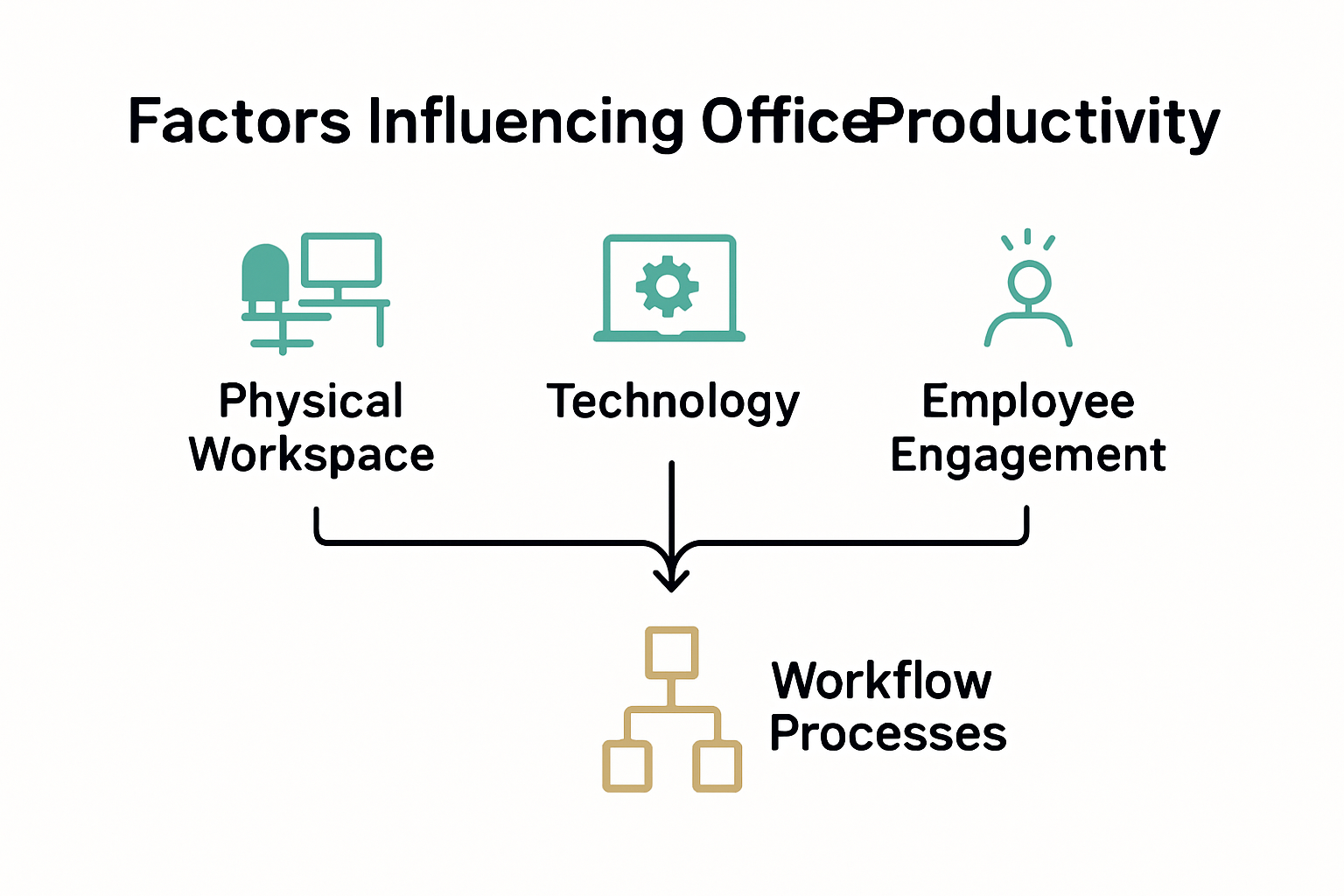
Office productivity is a complex ecosystem influenced by multiple interconnected elements. Understanding these critical factors helps organizations design strategies that optimize workplace performance and create environments conducive to exceptional work output.
To help organize the key elements that influence office productivity, the following table summarizes the critical factors, their descriptions, and their impacts as discussed in the article.
| Factor | Description | Impact on Productivity |
|---|---|---|
| Temperature Control | Maintaining optimal thermal comfort | Reduces discomfort, supports focus |
| Lighting Quality | Adequate natural and artificial illumination | Improves alertness and accuracy |
| Noise Management | Minimizing disruptive sound levels | Decreases distractions, boosts concentration |
| Ergonomic Design | Providing comfortable, supportive furniture | Reduces physical strain, supports stamina |
| Technological Infrastructure | Reliable, fast, and secure digital workspace tools | Enables seamless workflows and communication |
| Digital Collaboration Tools | Cloud platforms and project/task management software | Streamline teamwork and information access |
| Workplace Culture & Engagement | Supportive management, recognition, and development | Enhances morale and sustainable performance |
Physical Work Environment
The physical workspace plays a pivotal role in employee performance. According to research from the Journal of Environmental Health Science and Engineering, several environmental factors directly impact productivity:
- Temperature Control: Maintaining optimal thermal comfort
- Lighting Quality: Ensuring adequate natural and artificial illumination
- Noise Management: Minimizing disruptive sound levels
- Ergonomic Design: Providing comfortable and supportive workplace furniture
Each of these elements contributes to creating a workspace that supports rather than hinders employee performance. The right physical environment reduces physical strain and mental fatigue, enabling workers to maintain higher concentration levels and energy throughout the workday.

Technological Infrastructure and Tools
Modern productivity is deeply intertwined with technological capabilities. Organizations must invest in robust technological infrastructure that enables seamless communication, efficient task management, and smooth workflow processes. Key technological considerations include:
- Reliable and high-speed internet connectivity
- Cloud-based collaboration platforms
- Advanced communication tools
- Integrated project management software
- Cybersecurity systems that protect workflow continuity
Technology should function as an enabler, reducing friction in work processes and providing employees with tools that amplify their natural capabilities. The goal is creating a technological ecosystem that feels intuitive and supportive, rather than complicated or restrictive.
Understanding Tools and Techniques for Boosting Productivity
Improving office productivity requires a strategic approach that combines technological solutions, personal development techniques, and organizational practices. Successful productivity enhancement goes beyond simple time management and involves creating comprehensive systems that support consistent performance.
Digital Productivity Tools and Software
According to research from the Journal of Occupational and Environmental Medicine, modern digital tools play a crucial role in workplace efficiency. Organizations can leverage technology to streamline workflows and optimize individual and team performance:
- Project Management Platforms: Centralized collaboration and task tracking
- Time Tracking Applications: Monitoring work hours and identifying productivity patterns
- Communication Software: Enabling seamless team interactions
- Cloud-Based Collaboration Tools: Supporting remote and hybrid work environments
These digital solutions provide real-time insights, reduce administrative overhead, and create transparent communication channels that enhance overall workplace productivity.
Personal Productivity Techniques
Beyond technological interventions, individual approaches significantly contribute to workplace efficiency. Effective personal productivity techniques include:
- Implementing structured time management methodologies
- Practicing focused work intervals
- Developing consistent prioritization skills
- Creating personalized workflow optimization strategies
- Maintaining clear boundaries between work and personal time
Successful professionals understand that productivity is a skill that can be systematically developed through deliberate practice and continuous learning. The most effective techniques are those tailored to individual work styles and organizational requirements.
Real-World Examples of Improved Office Productivity
Successful organizations demonstrate that improving office productivity is not just a theoretical concept but a practical strategy with measurable outcomes. By implementing innovative approaches, companies can transform their workplace performance and achieve significant operational advantages.
Flexible Workspace Strategies
According to government research on workplace transformation, companies like Dell Technologies, American Express, and Aetna have revolutionized productivity through strategic workspace management:
- Dell Technologies: Shifted 25% of employees to remote work
- American Express: Saved $15 million annually through flexible work options
- Aetna: Reduced office space by 2.7 million square feet, saving $78 million yearly
These organizations prove that reimagining workplace structures can simultaneously reduce costs and enhance employee performance. Flexible work arrangements allow companies to optimize physical resources while providing employees with greater autonomy and work-life balance.
This table compares several real-world flexible workspace strategies adopted by notable companies, highlighting their approach and measurable outcomes.
| Company | Productivity Strategy | Outcome/Benefit |
|---|---|---|
| Dell Technologies | Shifted 25% of employees to remote work | Increased flexibility, performance gains |
| American Express | Flexible work options | Saved $15 million annually |
| Aetna | Reduced office space (2.7 million ft²) | Saved $78 million yearly |
Workflow Optimization Techniques
Productivity improvements extend beyond physical workspace design. Strategic workflow modifications can dramatically enhance organizational efficiency. Companies have successfully implemented techniques such as:
- Grouping similar tasks to minimize context switching
- Establishing clear performance metrics
- Creating structured yet adaptable work schedules
- Implementing cross-functional collaboration frameworks
- Developing targeted training programs for skill enhancement
These approaches demonstrate that productivity is not about working longer hours, but working more intelligently. By understanding individual and team dynamics, organizations can create environments that naturally drive higher performance and employee satisfaction.
Unlock Lasting Office Productivity with a Local Technology Partner
Is your team struggling to turn productivity goals into real results despite best efforts with digital tools and workspace improvements? The article on Understanding Ways of Improving Office Productivity highlights how essential the right blend of technology and support is to boost quality, efficiency, and workplace engagement. Even with strategic efforts, many Central Coast businesses feel stuck when technology systems slow them down or fail to protect valuable data. With so much riding on seamless operations, you deserve more than off-the-shelf solutions.
SRS Networks brings small and medium businesses in Salinas, Monterey, and beyond the expert IT partnership you need to finally eliminate tech frustrations, streamline workflows, and protect every aspect of your office performance. Let our team design tailored Managed IT Services, implement reliable Cloud Computing solutions, and ensure your critical data is always secure and recoverable. Visit SRS Networks now to schedule a technology assessment. Take the next step to empower your team with proven, local IT support—see how you can reach new levels of efficiency this quarter.
Frequently Asked Questions
How can I measure office productivity effectively?
Measuring office productivity involves evaluating the balance between input resources (like time and labor) and output results. Organizations should consider various performance metrics, including individual and team achievements, as well as specific key performance indicators aligned with their goals.
What role does technology play in improving office productivity?
Technology significantly enhances office productivity by streamlining workflows, facilitating communication, and providing tools that enable efficient task management. Investing in a robust technological infrastructure, like cloud-based collaboration platforms and project management software, is crucial for maximizing productivity.
What are some effective personal productivity techniques?
Effective personal productivity techniques include establishing structured time management methods, practicing focused work intervals, prioritizing tasks, and maintaining boundaries between work and personal time. These strategies help individuals optimize their workflow and enhance overall efficiency.
How can the physical work environment impact employee productivity?
The physical work environment directly affects employee productivity through factors such as temperature control, lighting quality, noise management, and ergonomic design. A well-designed workspace reduces physical strain and mental fatigue, enabling employees to maintain higher levels of concentration and energy.